Why Are We Seeing Measles and Mumps Again
The website for the Centers for Disease Control and Prevention currently leads its homepage with data about measles, a affliction considered eliminated in the U.S. in 2000.
Now, outbreaks take go such a business that the New York City suburb of Rockland Canton just barred minors not vaccinated for measles from public places for thirty days, and Gov. Jay Inslee declared a state of emergency in Washington two months agone because of the disease.
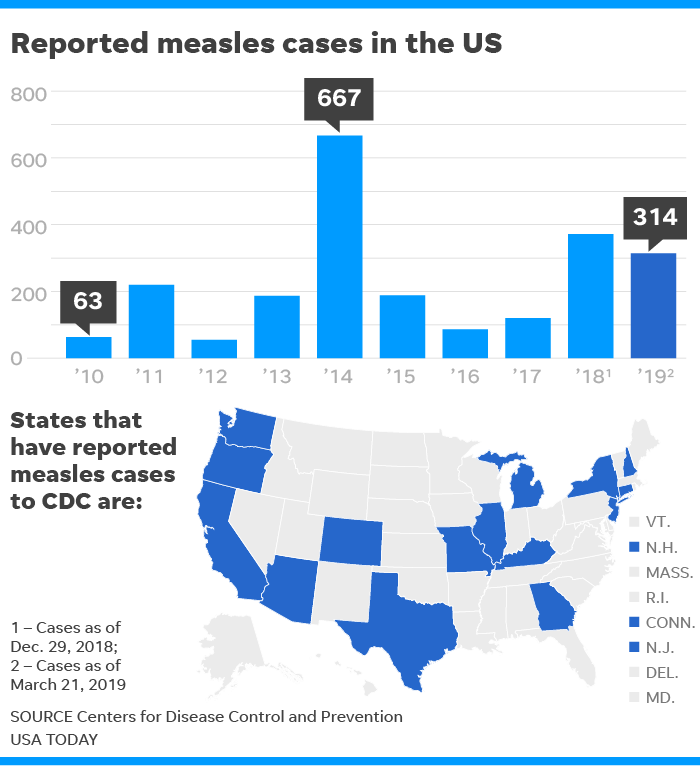
Washington's 74 incidents of measles rank second behind New York among the 15 states where cases accept been confirmed this year, according to the CDC, which lists 314 such instances nationwide every bit of March 21. That's more than than in any full twelvemonth this decade except for 2014 (667) and 2018 (372).
"The reason measles is coming back is that a critical number of parents have called not to vaccinate their children,'' said Paul Offit, director of the Vaccine Education Eye at Children's Infirmary of Philadelphia. "If you get to a few thousand cases, you'll starting time to see children die of measles again.''
The highly contagious affliction, whose early symptoms may include a loftier fever, coughing, runny olfactory organ and red, watery eyes, is not the but old-time disease making an unwanted comeback.
Mumps and pertussis (whooping cough) have been on the rise in recent years, and the previously devastating tuberculosis is notwithstanding causing trouble, though not at the rate it one time did.
"Recently, we've been seeing an uptick in a whole different variety of infectious diseases, and that includes diseases nosotros previously thought nosotros had trounce. Measles is probably the No. 1 example,'' said Judd Hultquist, assistant professor of infectious diseases at Northwestern University'south Feinberg Schoolhouse of Medicine.
"It's pretty incredible considering even in the late 1960s, early on 1970s, we were having so much success in coming upwards with new vaccines, new drug treatments, that nosotros really felt similar infectious diseases were going to be something we had beaten. And however, here we are 50 years later and they're making a comeback.''
Here'southward a look at some troubling illnesses that won't go away:
Measles
Symptoms may have a calendar week or two to appear, and shortly after that the patient may develop piddling white spots inside the mouth. That's often followed by a facial rash that starts at the hairline and spreads to other parts of the body. At that point, the fever may surge to dangerous levels, higher up 104 degrees.
What to know:Measles outbreak is affecting over 150 in New York county
Pneumonia and even death – often because of severe dehydration – may follow, and at that place's no cure for measles, although some medications may alleviate the symptoms.
Measles crunch:A quarter of all kindergartners in this county in Washington aren't immunized
A much improve alternative, public health experts say, is prevention through the MMR (measles, mumps, rubella) vaccine, which has a 97 pct rate of effectiveness later a 2nd dose (93 percent afterwards i). It is sometimes combined with immunization against chickenpox, or varicella, in what's known equally the MMRV vaccine, but it can only be administered to children from 12 months through 12 years of age.
Hultquist is among many who betoken out the spread of misinformation has led to more people opting out of vaccinating their children, assuasive for measles to brand a comeback. Last year's 372 cases were the second-highest total in more than two decades, and this year's stride would yield well over 1,000 cases.
In an analysis published in Oct, the CDC said vaccination rates for polio, MMR, hepatitis B and varicella remain steady and above 90 percent for U.S. children 19-35 months. However, the CDC also noted an increase in the number of minors 2 years old and under who received no vaccines from 0.nine percent in 2011 to 1.3 percent in 2015, consequent with the rise in the anti-vax move.
"More and more we're seeing people opting out of vaccinations out of a feeling they're in some fashion dangerous, which is admittedly and completely untrue,'' Hultquist said.
Mumps
As well the tell-tale puffy cheeks, the viral disease can also produce fever, headaches and musculus aches. It's most mutual among people who take extended close contact with each other, such as sports teams or college students.
"You lot are seeing more mumps,'' Offit said. "I'grand living in a city where at Temple Academy there are a hundred cases of mumps right now, and it spread to Drexel University and West Chester University.''
Offit said the mumps outbreaks are likely related to its vaccine's immunity diminishing later 10 years, even with a booster shot. Health officials are at present seeing more than cases among people in late adolescence and early on adulthood, so they're recommending a third dose for those in outbreak settings. That third shot may eventually become standard practice around age xvi-18, especially because mumps tin affect fertility.
Mumps has never been eradicated in the Usa, but from an average of 186,000 yearly reported cases when the vaccine was introduced in 1967, the numbers went downwardly to a few hundred in the 1990s. Yet, the figures spiked to the six,000 range in 2016 and 2017 before dropping to beneath 3,000 concluding twelvemonth.
Pertussis
The contagious respiratory disease leads to violent cough that impairs breathing and can be particularly dangerous, fifty-fifty fatal, for babies under a year of age.
Before the pertussis vaccine began to get widely administered in the mid-1940s, the annual number of cases nationally sometimes topped 200,000, with thousands of the kids dying.
The vaccine was extremely constructive – reducing whopping-coughing diagnoses to i,000-ii,000 through most of the 1970s and early on '80s – just concerns about side effects similar high fever and occasional seizures led to a reformulation in 1997.
Administered with immunization for diphtheria and tetanus, the vaccine is at present known as DTaP. All the same, the protection for pertussis wears off, and this decade the yearly instances accept averaged in the 25,000 range.
"Y'all're seeing more than pertussis now because we switched to that vaccine,'' Offit said. "We ended up trading efficacy for condom, and I don't think nosotros realized at the time, frankly, how big that trade was going to exist.''
Tuberculosis
This bacterial affliction, spread through the air when infected people cough, sneeze or speak, was the leading crusade of decease in this state in the early on 1900s and remains the world's leading infectious-illness killer. TB typically affects the lungs simply can also impairment the brain, spine and kidneys.
The incidence of tuberculosis in the U.S. has been decreasing for years, to a low of 9,029 new cases in 2018, down 0.7 percent from 2017. Despite advances in treatment, tuberculosis hasn't been wiped out, and likely won't exist for a while.
More:Almost 40 at Mankato State infected with tuberculosis
The CDC said a contempo model predicted that reaching the goal of eliminating TB – which would mean an incidence of less than i case per 1000000 people – won't exist achieved in this century without significantly increasing funding for detection and treatment.
Offit said the U.S. is among the few countries that doesn't regularly administer a TB vaccine. The illness is especially dangerous for people with a compromised immune system, such as those who are HIV-positive.
"Always since AIDS came into the U.South., tuberculosis increased,'' Offit said. "Those ii things are related.''
bowlinghishooked84.blogspot.com
Source: https://www.usatoday.com/story/news/health/2019/03/28/anti-vaxxers-open-door-measles-mumps-old-time-diseases/3295390002/

Post a Comment for "Why Are We Seeing Measles and Mumps Again"